
By Dr. Vamani Reddy, BDS, MDS | Paediatric Dentist, Manikonda, Hyderabad
Last reviewed: October 2026 | Dr. Vamani’s Dental Clinic, Bharath Plaza, Manikonda, Hyderabad
In this article
- Why festival season is hard on children’s teeth
- Which sweets do the most damage
- Smarter ways to serve sweets at home
- Hidden sugar your child may be eating
- How to handle relatives who keep offering sweets
- A simple routine for festival days
- Kids dental care in Hyderabad: what to book before and after Diwali
- Signs a cavity may already be forming
- If a tooth is knocked out or cracked during the festivities
- Frequently asked questions (FAQs)
- The short version
Kids dental care in Hyderabad gets harder every year around Diwali. The sweets arrive in boxes from relatives, the plates get refilled all evening, and the usual brushing routine slips. I see the result in my clinic every November.
Diwali falls in early November this year, so this is the right time to plan. You do not need to ban sweets. A few small changes in how and when your child eats them make a big difference to their teeth.
Why festival season is hard on children’s teeth
Most parents worry about how much sugar their child eats. What matters more is how often. Every time your child eats something sweet, the bacteria in the mouth turn that sugar into acid. That acid attacks the enamel for the next twenty to thirty minutes.
A child who eats one mithai after lunch gives their teeth one short attack. A child who nibbles sweets from morning to night gives them eight or ten. The enamel never gets a chance to recover.
Baby teeth are the most affected. Their enamel is thinner than an adult tooth, so a cavity can reach the nerve much faster. That is why festival weeks lead to so many emergency visits.
Which sweets do the most damage
Not all sweets are equal. The ones that stick to the teeth are the worst, because they keep feeding the bacteria long after your child has finished eating.
Chikki, toffee, caramel, jalebi and soft laddus all cling to the grooves of the back teeth. Dried fruits like dates and raisins are healthy in other ways, but they are also very sticky. Sugary fizzy drinks and packaged juices bathe the teeth in sugar and acid together.
Chocolate is actually kinder than most traditional sweets. It melts and clears from the mouth quickly. A square of chocolate after a meal does less harm than a sticky sweet eaten alone.
Smarter ways to serve sweets at home
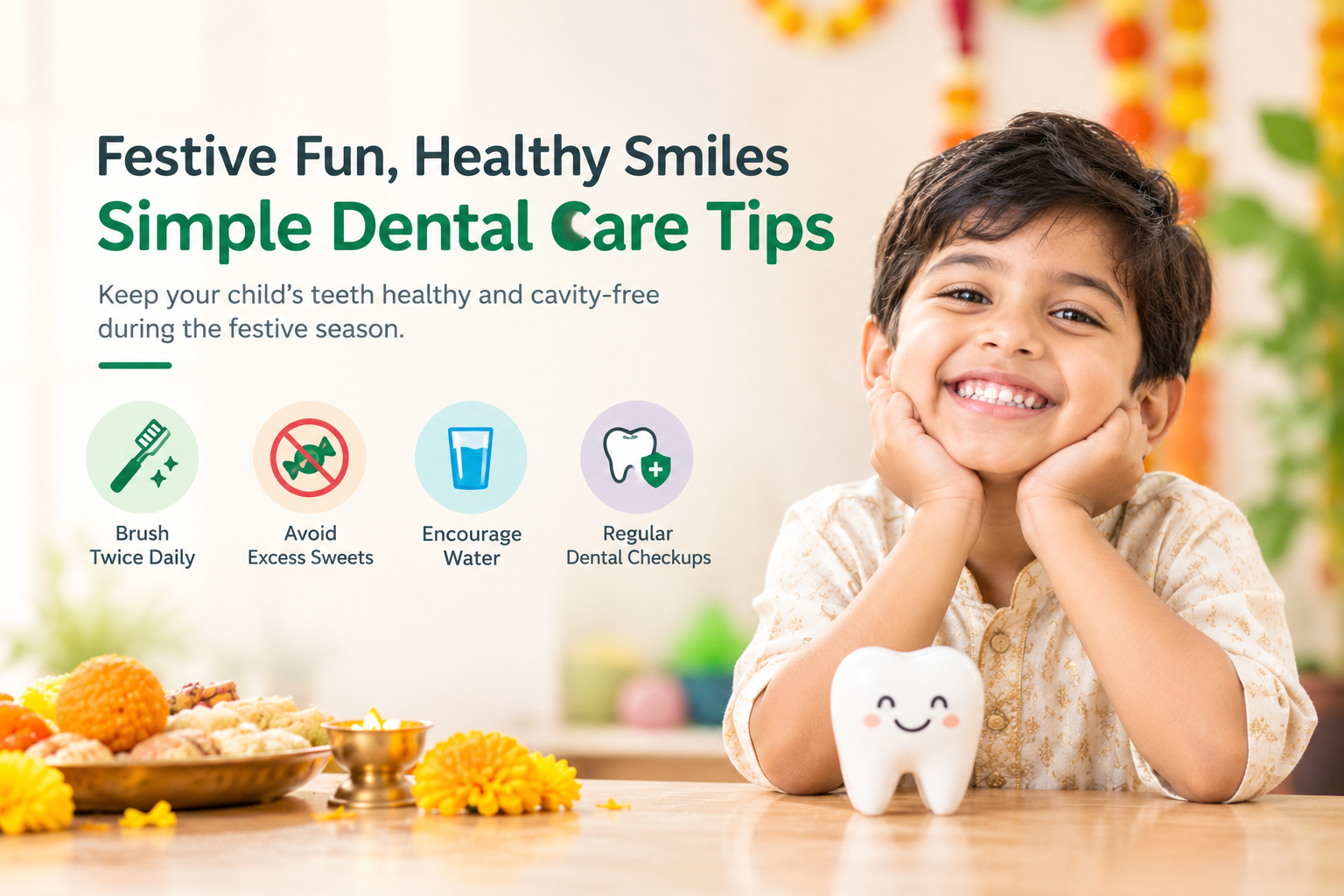
The simplest rule is to serve sweets with meals, not between them. Saliva flow is higher while eating, and it helps wash sugar away. A sweet after lunch is far better than the same sweet at four in the afternoon.
Give your child a set number of sweets for the day and let them choose which ones. This avoids the constant nibbling that does the real damage. It also turns sweets into a treat rather than a battle.
Keep the boxes out of reach and out of sight. A box left on the table will be opened twenty times a day. Put out a small plate instead, and take it away when it is finished.
Offer water after every sweet. A few sips rinse away much of the sugar. It takes ten seconds and costs nothing.
Hidden sugar your child may be eating
Sweets are easy to spot. The sugar in everyday foods is not. During festival weeks, children also eat more packaged snacks, flavoured milk, biscuits and juice drinks.
A small carton of fruit drink can hold several teaspoons of sugar. Sipping it slowly over an hour is worse than drinking it quickly with a meal. The same is true for flavoured milk in a feeding bottle at bedtime.
Check the label for sugar, glucose syrup and honey. If your child is sipping a sweet drink, switch it to water between meals. This one change protects teeth all year, not only at Diwali.
How to handle relatives who keep offering sweets
Festival visits mean plenty of well-meaning aunts and uncles. Refusing a sweet can feel rude, and children are rarely allowed to say no.
Talk to your child before you leave the house. Agree that they will take one sweet at each house and eat it with the meal. A warm line such as “thank you, we are keeping it for after dinner” works well and offends nobody.
You can also carry a small bottle of water. Offering a drink after the sweet becomes a habit very quickly. Children usually follow the routine without fuss once it feels normal.
A simple routine for festival days
Brushing at night matters most. Saliva slows down during sleep, so any sugar left on the teeth does its damage overnight. Please do not let a tired child skip it, even on the busiest festival evening.
Younger children need you to brush for them or after them. Most children cannot brush properly on their own until about seven or eight. Use a small smear of fluoride toothpaste for under threes and a pea-sized amount after that.
Brush for two full minutes, and pay attention to the back molars. Those deep grooves are exactly where sticky sweets hide. If your child had sweets late in the evening, brush once more before bed rather than relying on the earlier brush.
Kids dental care in Hyderabad: what to book before and after Diwali
A check-up before the festival gives me the chance to find early decay while it can still be reversed. A chalky white line near the gum is the first sign. At that stage, fluoride and better habits can stop it without any drilling.
Fluoride application is quick and painless, and it strengthens the enamel before the sugar season begins. Children with deep grooves in their back teeth may also benefit from sealants. These close off the grooves so food cannot get trapped.
A second check-up in December or January is just as useful. Cavities that started during the festival often show up a few weeks later. Catching one early means a small filling instead of a root canal.
If your child has never seen a dentist, this is a good moment to start. I explained what to expect in my article on your child’s first dental visit. It is a short, gentle appointment with no treatment involved.
Signs a cavity may already be forming
Do not wait for pain. By the time a child complains, the decay is often deep. Watch for a dark spot on a tooth, a chalky white band at the gum line, or a tooth that is suddenly sensitive to cold.
A child who starts chewing on one side only is also telling you something. So is a small bump on the gum that looks like a pimple. That can mean an infection at the root.
If decay has reached the nerve, the tooth can often still be saved. I explained how in my article on pulpectomy for children. Treating it early is always simpler than waiting.
If a tooth is knocked out or cracked during the festivities
Festival days mean crowds, running children and the occasional fall. A knocked-out tooth is an emergency, so it helps to know what to do before it happens.
If it is a permanent tooth, pick it up by the crown and never touch the root. Rinse it gently with milk, not tap water, and do not scrub it. Place it back in the socket if your child is old enough to hold it there, or keep it in a small cup of milk. Come to the clinic immediately, because the first thirty minutes matter most.
If it is a baby tooth, do not try to put it back. Call the clinic the same day so I can check the gum and the tooth underneath.
A baby tooth lost this way is lost early. That is the situation where a space maintainer is needed to keep the gap open. I covered this in my article on space maintainers for kids.
Frequently asked questions (FAQs)
Should I stop my child from eating sweets during Diwali?
No. Banning sweets makes children want them more. Serve them with meals, keep the portions small, and make sure your child brushes well at night.
Is it bad to brush right after eating sweets?
Brushing after a sweet is fine. The advice to wait applies mainly to acidic drinks like fizzy drinks and citrus juice. After those, rinse with water and brush half an hour later.
Are sugar-free sweets safe for teeth?
They are kinder than sugar, but they are not a free pass. Some still contain starch, and many are sticky. Brushing at night is still essential.
My child already has a cavity. Is it too late to prevent more?
Not at all. Treating the existing cavity and improving the routine stops it from spreading. Book a check-up so I can see exactly where things stand.
How often should my child see a dentist after the festival?
Every six months for most children. After a heavy sweets season, I like to see them sooner, around six to eight weeks later, to catch anything early.
The short version
Sweets themselves are not the problem. Constant snacking is. Serve sweets with meals, offer water afterwards, brush well every night, and book a check-up before and after the festival. If something goes wrong, call the clinic early rather than waiting for pain.
Get your child’s teeth ready for the festival season
A quick check-up and fluoride application before Diwali can prevent weeks of trouble. Call the clinic and we will find a convenient slot for your child.
Explore: Fluoride Application | Pit & Fissure Sealants | Preventive Dental Treatment