
By Dr. Vamani Reddy, BDS, MDS | Paediatric Dentist, Manikonda, Hyderabad
Last reviewed: September 2026 | Dr. Vamani’s Dental Clinic, Bharath Plaza, Manikonda, Hyderabad
In this article
- Why an empty gap is a bigger problem than it looks
- When a space maintainer is actually needed
- Types of space maintainers we use
- How this differs from what I discussed after pulpectomy
- What the appointment actually involves
- Looking after a space maintainer at home
- What happens if you skip it
- How to know if your child’s tooth was lost too early
- What it costs and whether it’s worth it
- Frequently asked questions (FAQs)
- The short version
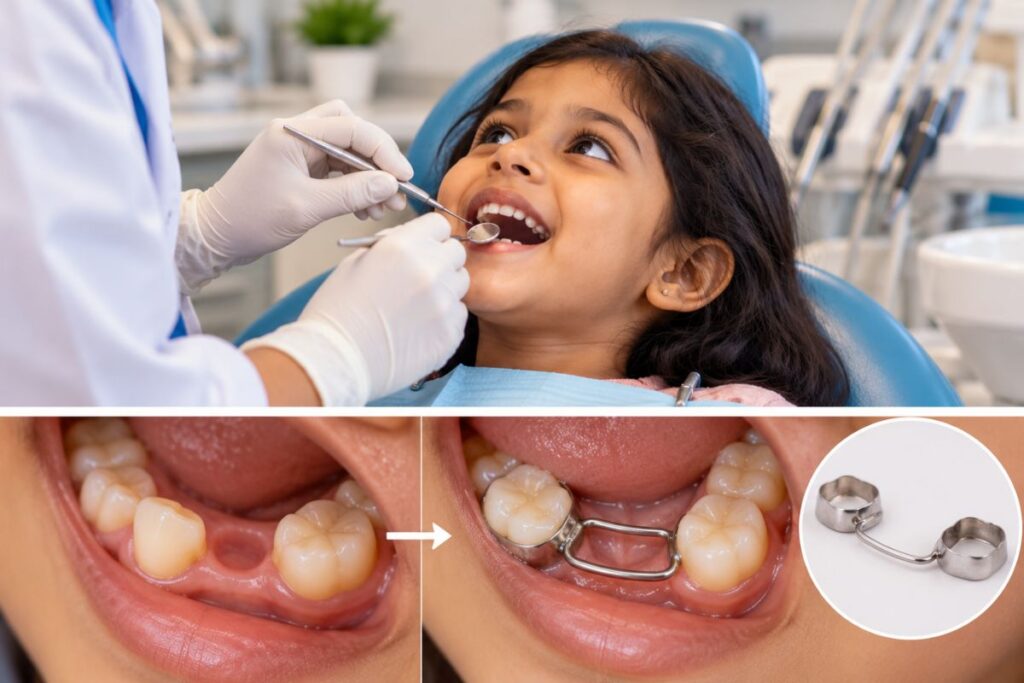
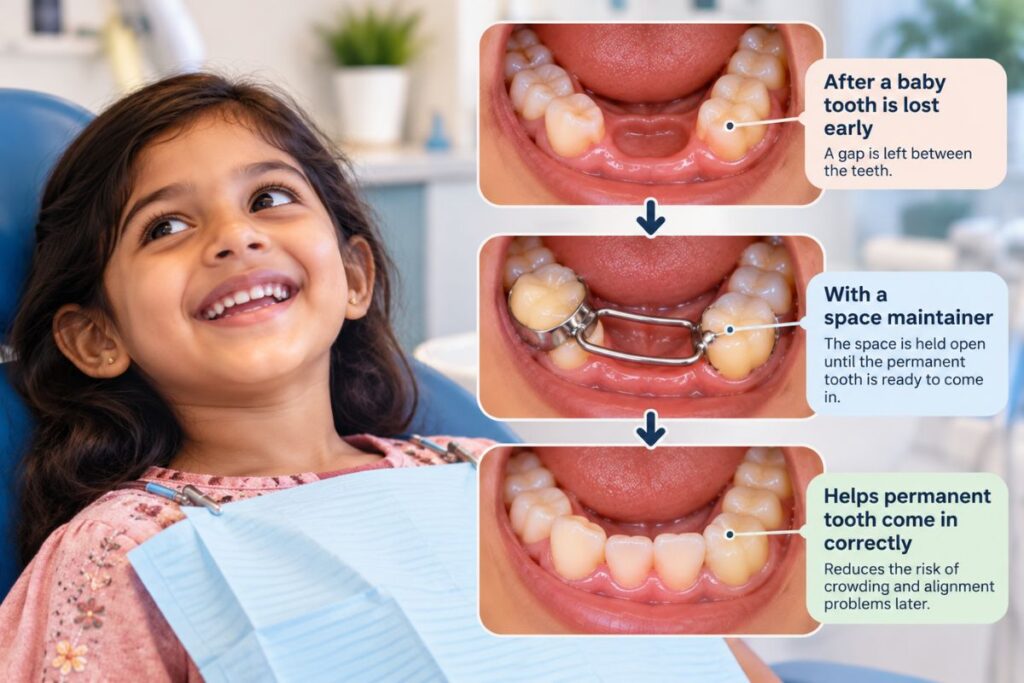
Space maintainers for kids come up in almost every conversation I have after treating a decayed baby molar. Most parents have never heard the term before that day. It is a small custom appliance that holds a gap open after a tooth is lost early. It gives the permanent tooth underneath somewhere to go once it is ready.
I mentioned this briefly in last month’s article on pulpectomy. There, I explained that extraction with a space maintainer is sometimes the better choice over saving a badly damaged tooth. This article covers what the appliance actually is, why it matters, and what happens if a parent skips it.
Why an empty gap is a bigger problem than it looks
Teeth are not fixed in place the way they appear to be. The moment a gap opens up, whether from decay, an accident, or an extraction, the teeth next to it begin drifting toward that space. This happens within weeks, and it is slow and painless, so nobody notices it in real time.
The permanent tooth underneath is often not ready for a year or more. By then, the gap has narrowed. The new tooth then has nowhere to land. It comes in crooked, gets stuck under the gum, or pushes through at an angle that affects the bite. A space maintainer prevents all of that by holding the gap at its original width.
When a space maintainer is actually needed
Not every lost tooth needs one. If a baby tooth falls out close to its natural exfoliation date, the permanent tooth is usually right behind it. There is no meaningful gap-closing window in that case. The cases where I recommend one are early losses, well before that natural date. Most often this follows decay that reached the point of extraction, or a fall or injury.
Back teeth, the molars, matter the most here. They hold space for the largest permanent teeth and stay in place the longest. Losing a front tooth early is more of a cosmetic concern in most cases, since the permanent front teeth tend to arrive sooner.
Types of space maintainers we use
A band and loop maintainer is the most common one. A metal band fits around the tooth next to the gap, with a loop extending across to hold the space. It is used when a single tooth is missing on one side.
A lingual holding arch is used when teeth are missing on both sides of the lower jaw. It runs along the inside of the lower teeth and holds several spaces at once from a single appliance.
A distal shoe is a more specialised option. It is used when a child has lost a second baby molar before the first permanent molar behind it has erupted. It has a small metal extension that sits under the gum. That extension guides the emerging molar into position, since there is no adjacent baby tooth left to anchor a regular band.
I decide which type fits based on an X-ray. That shows exactly where the permanent tooth sits and how much time is left before it is due to erupt.
How this differs from what I discussed after pulpectomy
In last month’s article, I explained something related. When a tooth is too badly decayed to save, extraction paired with a space maintainer can be the better call than pushing to keep it. The two treatments answer different questions. A pulpectomy asks whether we can still save the tooth itself. A space maintainer asks what happens to the space once a tooth, saved or not, is eventually gone.
Some children need both in sequence. A pulpectomy comes first, and later, if that tooth is still lost earlier than its natural date, a space maintainer follows. Others go straight from extraction to a space maintainer without a pulpectomy ever being attempted, when the tooth was too far gone from the start.
What the appointment actually involves
Fitting a space maintainer is not uncomfortable. I take an impression of the teeth, and the appliance is custom made to fit that specific gap, usually ready within a week. The fitting appointment itself takes about fifteen to twenty minutes. It does not require numbing in most cases, since the appliance clips or cements onto the adjacent tooth without touching the nerve.
Your child can eat normally once it is fitted. I usually advise avoiding very sticky or hard foods that could dislodge it. It stays in place until the permanent tooth is ready to erupt, at which point I remove it in a short visit.
Looking after a space maintainer at home
Brushing continues as normal. I would pay particular attention to the area around the band or loop, since food can catch there more easily than around a natural tooth. Flossing under a lingual arch takes a little more care, and I will show you exactly how at the fitting appointment.
Check the appliance occasionally for looseness. A loose band can shift out of position and stop doing its job. If your child mentions it feels wobbly or different, book a check rather than waiting for the next scheduled visit.
What happens if you skip it
This is the part parents underestimate the most. A closed gap does not just mean a slightly crooked tooth that gets fixed later. It often means several years of orthodontic treatment as a teenager. That treatment recreates space a small appliance could have held for a fraction of the cost and time.
In more complicated cases, the permanent tooth becomes impacted. It gets stuck beneath the gum with nowhere to erupt, and needs surgical intervention to bring it into position. A space maintainer, fitted at the right time, is almost always the simpler and cheaper path.
How to know if your child’s tooth was lost too early
Most parents cannot tell on their own whether a lost tooth was ahead of schedule. Baby teeth generally follow a predictable order, starting with the lower front teeth around age six and finishing with the second molars around age twelve. A tooth lost well before its expected age in that sequence is worth a check.
The clearest sign is the reason behind the loss. A tooth knocked out in a fall or removed because of deep decay is, by definition, ahead of schedule. A tooth that simply became wobbly and fell out on its own, with no injury or infection involved, is usually right on time.
When in doubt, bring your child in within a few days of losing any tooth. An X-ray tells me immediately how much time is left before the permanent tooth is due, and whether a space maintainer is worth fitting.
What it costs and whether it’s worth it
Parents sometimes hesitate at the idea of paying for an appliance for a tooth that was going to fall out anyway. I understand the instinct. But the cost of a space maintainer is almost always smaller than the cost of the orthodontic treatment needed later to recreate a closed gap.
Call the clinic with details of which tooth was lost. I will give you an accurate figure rather than a general range that may not apply to your child’s case. Cost also depends on which type of appliance is needed, since a distal shoe and a band and loop are priced differently.
Frequently asked questions (FAQs)
How long does a child need to wear a space maintainer?
It depends entirely on how far away the permanent tooth is from erupting. Some children wear one for six months, others for two years or more. I track this at every six-month check-up and remove it exactly when it has done its job.
Will my child be able to talk and eat normally?
Yes, after a short adjustment period of a day or two. Most children forget it is there within a week.
What if the space maintainer falls out on its own?
Bring your child in as soon as you can. The gap can start closing again within weeks of it coming loose. This is not something to leave until the next scheduled visit.
Does getting a space maintainer hurt?
No. Fitting one does not usually involve any drilling or injections, since it attaches to a healthy tooth rather than working on the tooth’s nerve.
Is a space maintainer the same as braces?
No. Braces move teeth into new positions, while a space maintainer simply holds an existing gap at its current width. Some children who wear one as a toddler still need braces later, but the appliance itself is a preventive step, not orthodontic treatment.
The short version
Space maintainers for kids exist for one reason: to stop nearby teeth from drifting into a gap before the permanent tooth is ready. They matter most after an early loss of a back baby tooth. Skipping one often trades a small appliance now for years of orthodontic work later. If your child has lost a tooth earlier than expected, ask about one at the same visit.
Has your child lost a baby tooth earlier than expected?
A space maintainer works best when fitted soon after the tooth is lost. Call the clinic and we will check whether one is needed and fit it before the gap starts to close.
Explore: Pulpectomy for Children | First Dental Visit Guide | Preventive Dental Treatment