
By Dr. Vamani Reddy, BDS, MDS | Paediatric Dentist, Manikonda, Hyderabad
Last reviewed: July 2026 | Dr. Vamani’s Dental Clinic, Bharath Plaza, Manikonda, Hyderabad
In this article
- Why parents wait and why I don’t blame them
- What actually happens at your child’s first dental visit
- What I want to talk to you about at that first appointment
- Why baby teeth matter more than people think
- What early decay actually looks like at home
- How often after the first dental visit
- Preparing your child, and yourself
- If your child is already older than one
- Frequently asked questions (FAQs)
- The short version
Your child’s first dental visit should happen earlier than most parents expect: by their first birthday, or within six months of the first tooth coming through, whichever happens first. Not at three, not when they start school, but by age one.
In practice, that is almost never what happens. Most children I see for the first time in my clinic are four, five, sometimes seven years old, and they are usually here because something already hurts. By then I am not doing a check-up. I am doing treatment.
Why parents wait and why I don’t blame them
A one year old with four or six tiny teeth does not look like someone who needs a dentist. There is nothing to clean, nothing to straighten, and no complaint. Add to that the very common belief that milk teeth do not matter because they are going to fall out anyway and waiting feels completely reasonable.
The problem is that decay in baby teeth moves fast. The enamel on a milk tooth is thinner and softer than on an adult tooth, so a cavity that would take two years to become serious in your mouth can reach the nerve in a child’s tooth in a matter of months. I have seen children under three with infections that needed a pulpectomy and in almost every one of those cases the parents told me the same thing: there was no pain until the week before they called.
Pain is a late signal in children’s teeth. It is not an early one.
What actually happens at your child’s first dental visit
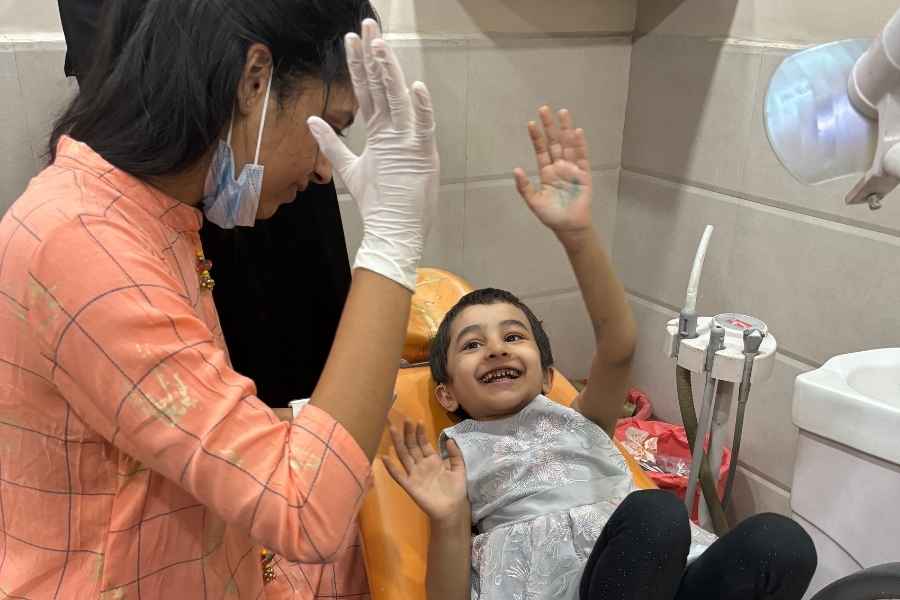
Parents often picture the first dental visit as a struggle. It usually isn’t, because at this age I am not doing much to the child at all.
For a baby or toddler, I use what is called a knee-to-knee examination. You sit facing me, your child sits on your lap facing you and then you lay them back so their head rests on my knees. They can see you the whole time. It takes a couple of minutes. I look at the teeth, the gums, the tongue, the way the jaws meet, and I check for any early white spots on the enamel which are the first sign of decay before a hole ever forms.
Then I clean off any soft deposits, sometimes apply fluoride varnish and spend most of the appointment talking to you rather than treating your child. That conversation is the real value of the visit.
What I want to talk to you about at that first appointment
Bottle and night feeding is usually first. A child who falls asleep with a bottle of milk or who feeds through the night after teeth have come in, is bathing those teeth in sugar for hours. This is the single most common cause of early childhood decay I see and it is entirely preventable once a parent knows about it.
Then brushing. Most parents start too late and stop supervising too early. Teeth should be wiped or brushed from the day the first one appears and a child does not have the hand control to brush properly on their own until roughly age seven or eight. Until then, you brush for them or after them.
We also talk about fluoride, which worries a lot of parents in Hyderabad because of what they have read online. I will tell you exactly how much is appropriate for your child’s age, and where our local water supply sits, so you are making that decision with real numbers rather than a WhatsApp forward.
And we talk about habits. Thumb sucking, prolonged pacifier use, mouth breathing, tongue thrusting. All of these change how the jaws grow, and all of them are far easier to address at two than at eight.
Why baby teeth matter more than people think
Milk teeth hold space. Each one is keeping a gap open for the permanent tooth that will replace it, and it does that job until roughly age twelve for the back teeth. If a baby molar is lost early to decay, the teeth on either side drift into the empty space, and the permanent tooth underneath has nowhere to come up. That child ends up in braces at eleven for a problem that started at four.
They also matter for speech, for chewing, and for confidence. A child with visibly decayed front teeth learns quite quickly not to smile with their mouth open. I would rather that never starts.
What early decay actually looks like at home
Most parents are watching for a brown or black spot. By the time you see that, the decay has already broken through the enamel surface and a filling is almost certain.
The earlier sign is a dull, chalky white band running along the gum line, most often on the upper front teeth. It looks a little like a smear of toothpaste that will not wipe off, and it is easiest to see just after you have dried the teeth with a tissue. That stage is called demineralisation, and it is reversible. Fluoride, a change in feeding pattern, and better brushing can genuinely halt it without any drilling at all. Once it becomes a cavity, that option is gone.
The other thing worth checking is the biting surface of the back molars once they come in, usually around age two to three. Those surfaces have deep natural grooves that a toothbrush bristle cannot physically reach into. If your child’s grooves are deep, sealants are a quick, painless way to close them off before food ever gets trapped there.
How often after the first dental visit
Every six months for most children. Some need to come more often, usually those with a history of decay, deep grooves in the back teeth, or enamel that has formed unusually. I will tell you which category your child is in rather than giving you a blanket answer.
The other reason for the six month rhythm is familiarity. A child who has been coming to the same clinic since they were one does not associate a dental chair with pain, because in their memory nothing painful has ever happened there. That single fact makes every future appointment easier, including the ones where real treatment is needed. Children who first meet a dentist during an emergency carry that memory for years.
Preparing your child, and yourself
Keep it simple. Tell them we are going to count their teeth. Avoid words like injection, drill, pain, or brave, even in reassurance, because a child who is told there is nothing to be scared of now knows there is something to be scared of.
Book a morning appointment if you can, when they are rested. Bring them along to a sibling’s or your own appointment first if that is easy to arrange. And if your child cries at the first dental visit, which some do, that is not a failed appointment. It is a first one.
One request I make of every parent: please do not promise your child that the dentist will not do anything. If treatment turns out to be needed, that promise is the thing that breaks their trust, not the treatment.
If your child is already older than one
Then the right time is now. There is no age at which a first dental visit stops being worth it, and nothing to feel guilty about. A large share of the children in my chair every week are first-timers at five or six, and most of them need far less work than their parents feared.
What I would say is this: do not wait for a complaint. A check-up when nothing hurts is a ten minute appointment. A check-up after a week of night-time pain is a different conversation entirely, and a more expensive one.
Frequently asked questions (FAQs)
My child has no cavities and brushes twice a day. Do they still need a visit?
Yes. Early decay does not look like a hole, it looks like a chalky white line near the gum, and it is very hard to spot at home. Catching it at that stage means fluoride and a change in habits rather than a filling.
Is dental X-ray safe for a small child?
The radiation from a single dental X-ray is extremely low, well within the safety limits set out by the Indian Dental Association, and I do not take them routinely at a first visit. I take them when there is a specific reason, such as decay between teeth that I cannot see directly, and I will always explain why before I do.
What if my child refuses to open their mouth?
Then we do what we can and try again. I do not force a first examination. Sometimes the first appointment is just the child sitting in the chair, seeing the room, and going home. That is progress, and it makes the second appointment straightforward.
How much does a first dental visit cost?
A consultation and examination is a small fraction of what a pulpectomy or crown costs later. Call the clinic and we will tell you the exact figure for a check-up before you come in, so there are no surprises.
My child’s permanent tooth is coming in behind the baby tooth. Is that a problem?
It is common and usually sorts itself out. The baby tooth is meant to loosen as the permanent one pushes up, and sometimes the permanent tooth takes a path just behind it instead. If the baby tooth is already wobbly, let it come out on its own. If it is still firm after a few weeks and the permanent tooth is clearly through, bring your child in and I will check whether the baby tooth needs help coming out.
Can I bring my child to a regular dentist instead?
You can, and many general dentists treat children well. The difference with paediatric training is mostly in behaviour management and in knowing how a growing jaw develops. If your child is anxious, has special healthcare needs, or needs treatment rather than a check-up, that difference matters.
The short version
By the first birthday, or six months after the first tooth. Every six months after that. Brush for them until they are seven. No bottle in bed. And if your child is already past one and has never seen a dentist, book now rather than waiting for a reason.
Book your child’s first dental check-up in Manikonda
A first dental visit takes about ten minutes and there is no treatment involved. Call the clinic and we will find a morning slot that suits your child’s routine.
Book an Appointment Call +91 70328 24343
Explore: Preventive Dental Treatment | Fluoride Application | Pit & Fissure Sealants